A newsbasket is on-line Internet publication containing comprehensive aggregated collections of information.


Showing posts with label ElderCare. Show all posts

Saturday, June 26, 2010

Fell On Floor and Can't Get Up, how to help

About Human Kinetics
Human Kinetics, mission is to produce innovative, informative products in all areas of physical activity that help people worldwide lead healthier, more active lives.

Human Kinetics is committed to providing quality informational and educational products in the physical activity and health fields that meet the needs of our diverse customers.
---
So you or your caring partner fell and is having trouble getting back up.

Here is an edited excerpt from Health Professionals’ Guide to Physical Management of Parkinson’s Disease
found on http://www.humankinetics.com/excerpts/excerpts/assisted-floor-transfer-techniques-for-patients-with-parkinsons-disease

"Assisted floor transfer techniques for patients with Parkinson's Disease
By Miriam P. Boelen, PT"

"Assisted Floor Transfer Techniques"

When the caregiver helps the patient up from the floor, both must be kept safe. If this is not possible, additional help such as a medical alert system may be needed. If possible, the gait belt should be snug for better leverage.

Transfers should be coordinated between the patient and caregiver to ensure simultaneous maximal effort and to minimize strain on both. The caregiver can accomplish this by giving instructions such as “On the count of three try rolling onto your hands and knees” or “On the count of three try to stand up.” Because of Parkinsonian symptoms, the patient may not initiate movement at the count of three.

The caregiver should be advised of this possibility so that she or he can delay giving assistance until the patient starts. Coordination of effort will avoid placing excessive strain on the caregiver. Caregivers should be encouraged to use optimal lifting body mechanics. .....

* Assisted side lying to hands-and-knees position. The optimal hand placement of the caregiver is to position one hand under the bottom hip and the other hand under the gait belt. The caregiver pulls up on the patient’s hips as if turning a big wheel (figure 11.6, a and b). The caregiver should flex the knees to facilitate lifting with the legs rather than the back.


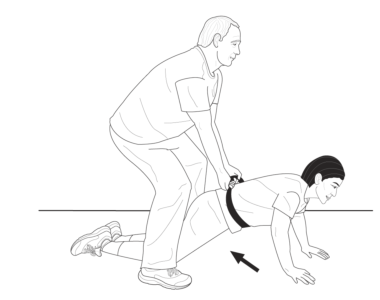
* Assisted prone to hands and knees. If the patient has strong arms, the caregiver (with proper body mechanics) can straddle the patient, grab the gait belt, and lean back while pulling up on the belt. At the same time the patient pushes with the arms (figure 11.7). As the patient walks her or his hands backward, the caregiver walks backward and guides the hips into the all-fours position.


* Assisted half kneeling to standing. The caregiver stands on the side of the patient that requires greater support. This positioning allows the patient to assist with his or her strongest side, which reduces difficulties in general. The caregiver places one hand on the gait belt and the other arm under the patient’s axilla (figure 11.8).

What to Do After a Fall

Patients often want to get up from the floor immediately after a fall. This desire may be due to the embarrassment of falling or their concern about their ability to get up. Sometimes patients do not think about the fact that after they have fallen, they cannot fall any farther and should be in no hurry to get up. Bystanders occasionally offer a helping hand, but their help may cause greater destabilization or irritate an already arthritic joint. Educating the patient about how to guide bystanders will help minimize these problems. Here are some general guidelines about what to tell your patient:

1. Do not try to get up right away.

2. Before attempting to get up, mentally note whether any areas feel injured. If you suspect injury, seek medical attention.

3. Attempt to relax for a moment before getting up.
.....

5. Before attempting to get up, someone should bring a chair close to you if needed so that you can use it for support to get up.

6. An additional chair could be placed behind you if you have difficulty turning. After you are standing, you can sit on the chair without having to turn.

This is an brief excerpt from Health Professionals’ Guide to Physical Management of Parkinson’s Disease. found on http://www.humankinetics.com/excerpts/excerpts/assisted-floor-transfer-techniques-for-patients-with-parkinsons-disease


----
A gait belt is a device used to transfer people from one position to another or from one thing to another. For example you would use a gait belt to move a patient from a standing position to a wheelchair. The gait belt is customarily made out of cotton webbing and a durable metal buckle on one end. The gait belt is worn around a patient's waist. The purpose for this is to put less strain on the back of the care giver and to provide support for the patient
--
Points to Remember: More than one caregiver may be needed. Belts with padded handles are easier to grip and increase security and control. Always transfer to resident's strongest side. Use good body mechanics and a rocking and pulling motion rather than lifting when using a belt. Belts may not be suitable for ambulation of heavy residents or residents with recent abdominal or back surgery, abdominal aneurysm, etc. Should not be used for lifting residents. Ensure belt is securely fastened and cannot be easily undone by the resident during transfer. Ensure a layer of clothing is between residents' skin and the belt to avoid abrasion. Keep resident as close as possible to caregiver during transfer. Lower bedrails, remove arms and foot rests from chairs, and other items that may obstruct the transfer

Thursday, June 10, 2010

News from Pleasantries Adult Day Services June 2010

Babies evoke a positive emotional response in most older adults. When our guests are able to hold a baby, their day is better. The interaction is priceless.The smiles shared and the sweet baby talk create a happy environment. We are lucky to have guests whose grand-children visit us.
Evie holding Jackson, Leslie's grandson
We have multiple days where children will visit and interact with our guests.
Intergenerational activity is mutually beneficial. While the children experience diminished fear of an older adult and enjoy the contact with our guests, the guest experiences a sense of increased self-worth, and an improved emotional state. My guests are able to carry the positive emotions throughout their day.
Arthur holding Jackson, Leslie's  grandson.
Now we know what has been eating our lillies!
Deer in our yard
At the breakfast table, my guest, Ann said, "There are two animals in the yard." As I looked out, I was amazed to find two deer grazing. We went out on the deck and I was able to capture them on camera as they leaped away. Pretty awesome!

Tammy Pozerycki
Owner & Director


Monday, May 3, 2010

How to make a visit to the physician easier for AD patient.

Pleasantries Adult Day Services - Marlboro, Massachusetts - Alternative Alzheimer’s care
Tammy Pozerycki
Owner & Director

Writes in a
Pleasantries A.D.S. newsletter:
It is important that your loved one with Alzheimer's disease have regular visits to his or her physician. These visits should address all medical and behavioral issues which may be related to Alzheimer's disease. In order to experience a productive appointment with the physician, try the following suggestions:

* Choose a "good" time of day for the appointment time (most likely morning will be best.)

* Bring along an activity that your loved one enjoys (books, sorting activity, coloring, etc) as well as a snack and water. This will prepare you for an unexpected wait time.

* Bring a list of all medication including over-the-counter. Create a list of questions in preparation of the minimal time available with the doctor.

* Depending on your situation, it may be helpful to bring someone else with you, such as a close friend or family member.

* Discuss what you can expect for the future and advance directives.

* It is good to take notes as there will be much discussed in a short amount of time.

* Be open and honest. If you are not happy or satisfied with the physician, make he or she aware of your concerns. Switching physicians can be confusing to your loved one and possibly detrimental in the longrun. If discussed, the issues may be resolved.


Saturday, February 6, 2010

NFCA, National Family Caregivers Association

The National Family Caregivers Association educates, supports, empowers and speaks up for the more than 50 million Americans who care for loved ones with a chronic illness or disability or the frailties of old age. NFCA reaches across the boundaries of diagnoses, relationships, and life stages to help transform family caregivers' lives by removing barriers to health and well being.

Membership is free to family caregivers, and includes a quarterly, e-mailed newsletter. For those who would rather receive a print copy of the newsletter, NFCA offers an upgraded, Family Caregiver Plus membership at the special introductory rate of $10/year. Click here to join on-line.

Monday, February 1, 2010

Raise your hand if you're a caregiver.

How Can Doctors and Caregivers Work Together?

from: HealthBridge's In-Home Care Blog

Dr. Pauline Chen took an insightful look at this topic in her "Doctor and Patient" column in the New York Times. She writes:

For all our assertions about the importance of caring in what we do, doctors as a profession have been slow to recognize family members and loved ones who care for patients at home. These “family caregivers” do work that is complex, physically challenging and critical to a patient’s overall well-being, like dressing wounds, dispensing medication, and feeding, bathing and dressing those who can no longer do so themselves.

Many of these caregiving tasks were once the purview of doctors and nurses, a central component of the “caring professions.” But over the past century, as these duties increasingly fell to individuals with little or no training, doctors and even some nurses began to confer less importance, and status, to the work of caregiving.


Sunday, November 1, 2009

A Study of need for services when reaching age 65

Comparing Costs For In-Home Care, Nursing Homes, RCFE Assisted Living And Adult Day Care | Elder Care Residential Services
A 2008 long term care study done by Prudential insurance has some surprising information regarding the costs of care for services needed as we age. This is information is important to assist in making plans for the “golden years”.

The study shows that the average cost of a nursing home can exceed $70,000 a year for a semi private room. A break down of the daily charges is $194 per day. A private room can exceed $79,000 a year or $217 a day. These costs will, of course depend on the area of the country you live in. Some areas will be more and some less. It was also noted that there has been a 7% increase in the cost of living in a nursing home over the past 2 years. Nursing home costs have had an increase of over 30% in the past 5 years.

Assisted living facilities have seen the greatest increase in costs over the past 2 years. The average for living in an assisted living facility rose to nearly $39,000 per year. This is an average daily charge of just over $100 per day.

There was an average of a 15% increase in rates for the assisted living facility that provide care for Alzheimer’s and dementia patients.

In -home care has had the smallest increase rate of all the service providers. The rate of in-home care has had an increase of 5% over the past two years and only 17% over the past 7 years.

The average cost for a certified nursing assistant providing in-home care is $21 per hour. The services provided by a certified nursing assistant are bathing, dressing and care provided under the supervision of a register nurse. These services are ordered by a physician and generally covered by insurance. These services are only provided intermittently and for a limited amount of time.

The 2008 Genworth Financial study of cost of care also covers the non skilled in home care. This is a growing segment of the in-home care services, as many individuals want to remain in their homes as long as possible.

The average cost for homemaker services is $18 an hour. The rate of these services has increased by 4% over the last year. A homemaker provides companionship, light housekeeping duties, assistance with cooking and running small errands.

In- home care also provides home health aides. These individuals are able to provide basic assistance with personal care, but are not permitted to perform and medical tasks.

The average rate of a home health aide is $19 an hour. This is an increase of 3% over the past year.
--

This lengthy article is well worth the read. http://ow.ly/15YGwf

NOTE: they show average values, you will find costs in your area may differ wildly.
--

I suggest following the blog http://ow.ly/15YGwf provided by:

Elder Care Residential Services

Mailing address:
610 Cypress Street
Pismo Beach, CA 93449
805-473-7400
FAX: 805-473-4704

Cell: 805-452-3225 9am TO 5pm Pacific Time

info@eldercareresidentiaservices.com


Tuesday, October 27, 2009

Long-term care insurance program

Long-term care insurance program gains in House - Boston.com

a new long-term care insurance program to help seniors and disabled people stay out of nursing homes. The voluntary program would begin to close a gap in the social safety net overlooked in the broader health care debate,
More than 10 million people currently need long-term care services, a number that's only expected to grow as the baby boom generation ages. But most families whose elders can no longer care for themselves have to scrape to find a solution.

The cost of nursing homes averages $70,000 a year, and a home care attendant runs about $29 an hour. Medicare only covers temporary nursing home stays. Middle-class households have to go through their savings before an elder can qualify for nursing home coverage through Medicaid.

The new proposal is called the Community Living Assistance Services and Supports Act, or CLASS Act, and passing it was a top priority for the late Sen. Edward M. Kennedy, D-Mass. The Obama administration also has said it should be part of health care overhaul legislation.

In return for modest monthly premiums while they are working, people would receive a cash benefit of at least $50 a day if they become disabled. The money could be used to pay a home care attendant, purchase equipment and supplies, make home improvements such as adding bathroom railings, or defray the costs of nursing home care.


Saturday, October 24, 2009

NORCs | naturally occurring retirement communities

There are some federally funded programs to bring services to what are called NORCs, or naturally occurring retirement communities. For instance, in Philadelphia and New York City a van with a nurse will come to a building that has a large population of elderly people and provide health services on the spot. Similarly, intentional communities, driven by consumer involvement, bring the services of a retirement community to seniors in their homes. Beacon Hill Village in Boston is an example. Both are examples of trying to let seniors age in place.
--------------------------------------------------------------------------------

Robin Gerber is the author of Barbie and Ruth, the biography of Ruth Handler, the founder of Mattel Toys and creator of Barbie.

Caregivers-in-Waiting: Boomers Struggle to Map Out Plans for Aging Parent s By: Robin Gerber

The Diabetes Health Care Crisis

http://oregoneldercareservices.com/?p=712
The Diabetes Health Care Crisis
People with Diabetes Don't Have Access to Adequate and Affordable Health Care

* Health insurance policies don't cover basic diabetes needs and reward crisis care, not the continuous care needed to prevent a medical crisis.
* Pre-existing condition exclusions prevent people from enrolling.
* Health insurance premium surcharges for diabetes drive premiums above what individuals and small businesses can afford.
* Medicaid eligibility limits leave many low income people unable to access health insurance.

Health Insurance Options 65 and Above


The following options may be available to you.

Medicare
Medicare provides health insurance benefits to persons 65 and older, persons under 65 who are disabled, and individuals with End Stage Renal Disease (ESRD).

Medicaid
Medicaid provides medical care to certain individuals and families with low incomes and resources.

TAA Tax Credit
TAA is a tax credit available to workers who have lost their jobs or whose hours of work and wages have decreased as a result of increased imports.

Prescription Assistance
Most pharmaceutical companies have established patient assistance programs to help uninsured individuals get the medications that they need to stay healthy.

Medigap
Medigap policies are available to Medicare-eligible individuals. They can be purchased from private health insurance carriers and provide benefits that are otherwise not included in Medicare Part A or B

Additional Resources:


Sharing bad news with an aging parent

http://oregoneldercareservices.com/?p=712
Crucial Conversations
So, here’s the big question. What can you do to make handing in his car keys something your father wants to do? Or something he is at least willing to tolerate?

Answer: Don’t equate taking away the keys with helplessness, boredom, and the complete loss of independence.

Kerry Patterson is author of three bestselling books, Influencer, Crucial Conversations, and Crucial Confrontations. Read the rest of his answer to this very important question here. http://ow.ly/15X2Vp


Thursday, October 22, 2009

Skype lets you talk and video conference over the Internet

"Enjoy the World, hobbies, crafts, creative pastimes, e-mail,web based Conversations, Blogs, Articles"
Skype is a little piece of software that lets you talk and video conference over the Internet with anyone, anywhere in the world for free while viewing each other on your computer screens.

This Listen-Zone describes one of several ways to set up and use Skype

Basic Requirements for Skype
# A high speed Internet connection
# a personal computer (Your computer must have Windows 2000, XP or Vista to run Skype)
# a webcam, a microphone (some web cams have a built in microphone) and speakers attached to your computer). Many lap-tops have built in speakers, some have built in webcam. If you are concerned with the audio being overheard you can use a headset with microphone
# first install the camera's software on your computer
# Then Connect the camera with the USB cable to any of the the computer's USB sockets (ports).
Many computers will automatically recognize that you plugged the webcam in and it will tell you there is a new device on the computer
# With the webcam connected you have also connected the microphone that is built into the webcam to the computer. You can now adjust the audio settings using the webcam controls or wait until you have installed Skype.
# The Logitech installer will guide you through the con figuration of the audio. You may download from the Logitech site or from Skype.
# Skype provides the software free of charge. After you have Skype installed they have additional services that you buy into.
# This article is limited to free services over the Internet to anyone, anywhere in the world for free while viewing each other on your computer screens.
# You will be asked to choose a Skype name
This the name or nickname that people will use to call you (connect with you) on using Skype. The Skype Setup Wizard will appear and guide you through the rest of the installation.
# Make certain peakers are plugged in and volume turned up. (or if using a head set plug it in)
# Now call the Skype Test service. It is an automated service that you call and it calls you back so that you know you are ready to Skype.
# Make your first call
Select your friend's Skype Name and press the big green call button.
# Sign up for a Google Account and for a Google gmail account

Monday, October 12, 2009

KnowItAlz is an Alzheimer's resource focused on the caregiver

Company Info - KnowItAlz.com Blog
KnowItAlz is an Alzheimer's resource focused on the caregiver. We give caregivers the opportunity to get current information, participate in a community and gain additional insights about caregiving for someone with Alzheimer's.

More than 26 million people worldwide have Alzheimer's disease, and a recent forecast says the number will quadruple by 2050. At that rate, one in 85 people will have the brain-destroying disease in 40 years.

Alzheimer's disease not only affects the person who has been diagnosed, but almost always also impacts the family members and friends who become caregivers. Caring for an Alzheimer's patient can be emotionally, psychologically and financially draining, and a support system often difficult to find. As the disease progresses, caregivers often find themselves cut off from friends, other family members and regular social activities.

In addition, most caregivers have the additional responsibilities of full time jobs and caring for a family of their own, as well as the responsibility of caring for a parent, spouse or other loved one. As a loved one begins to experience the many often difficult behavioral changes, even the most dedicated caregivers will struggle with guilt, resentment or frustration, at some point in their role as caregiver. Finding a balance is critical.

KnowItAlz.com provides, information and useful Alzheimer’s related resources, but more importantly a community of caregivers to providing the necessary support as you take on this difficult, yet often rewarding journey.

Our content is a combination of information from experts in both the Alzheimer’s and geriatric fields, as well as “real life” experts like you who have first-hand experience as a caregiver. Our goal is to build a community that connects caregivers to the information that can help them at every stage, as well as the opportunity to see the lighter side of caregiving—and yes, there is one!

The KnowItAlz Group was founded in 2007 by Kathy Hatfield and Nancy Hatfield.


Saturday, October 10, 2009

Grief is a natural part of life–and change–any change can trigger grief.

Grief Starts Early With Alzheimer’s, Ways to Honor The Grief Process «
Ways to Honor Our Grief:

* Take some photographs. See the beauty in vein-riddled hands and silver-white hair. There’s a sense of beauty that comes with aging, I liken it to the beauty and intricacy of a spider’s web. Even when the photographs reveal the ravages of time and disease, there’s something important about acknowledging today–just as it is.

* Dig out some old photographs–baby pictures, grade school, high school, the dating years, wedding photos. Remember who your loved one is–and was. Create a bridge by taking note of each decade, each life event. Display these photos so when grief comes, you can ease its sting by acknowledging what an amazing life journey they’ve had–and you’ve had with them.

* Write letters and share what you’re experiencing. Even if no one ever reads them, you need to write them. Grief is like a suitcase we carry with us–and if we have a place to put it–our thoughts, our worries, our memories–when we write them, we ease our own emotional load.

* Talk to those who share your experience. Call your sister, a cousin, or a friend who has been through a similar situation. Knowing that someone will listen to you, someone you can reminisce with, confide in–makes our grief bearable

--

Carol O'Dell's blog speaks to caregivers around the country. Carol offers suggestions, ideas and insights that will help others.

While Carol's blog is supported by Dakim Brain Fitness, Carol is not blogging to promote the Dakim company or products..

Motivation And Improving Health In Older Adults, Medical News Today

Boosting Motivation And Improving Health In Older Adults, With The Use Of A Simple Tool
Researchers from Boston University School of Medicine (BUSM) have identified a tool, the "Getting-Out-of-Bed (GoB) measure" to assess motivation and life outlook in older adults. The study, which appears in the October issue of the /i>Journal of Psychosocial Oncology, shows that the tool has the potential to be an easy-to-use measure to bolster motivation and thus, improve health behaviors and outcomes in the growing population of older adults.

Wednesday, October 7, 2009

Center for Aging Families Blog | Beverly Parsons

Center for Aging Families - Beverly Parsons Bio
Beverly Parsons, LGSW
Licensed Graduate Social Worker

Beverly is a caregiver, who has spent the last decade finding solutions to the thorny and often very difficult and unclear issues that caregivers face. She is a licensed social worker who has 10 years of geriatric care management experience working with caregivers and aging families.

Beverly draws on 30 years of personal and professional training to provide a unique approach of psychotherapy for caregivers and elders, using self-awareness, working with emotions, conversation and presence. Beverly is an adjunct faculty member at the Community College of Baltimore County, Elder Care. She was a research assistant at the National Institute on Aging and was trained by the Alzheimer’s Association as a group facilitator. She is trained in Elder Mediation to assist families in the decision-making process concerning aging issues.

Twitter: http://twitter.com/AgingFamilies


Seniors, Care-Partners, take active role in their care

“Doc Tom” Ferguson A Voice of the Patient Engagement Movement
An engaged patient plays an active role in his or her care. Or, as e-patients.net founder “Doc Tom” Ferguson said, “e-Patients are Empowered, Engaged, Equipped and Enabled.”

We who’ve become e-patients don’t wait for our providers to tell us everything; we get it in gear, we ask questions, we do what we can to help.
Trust yourself.
You know more
than you think you do.

Tuesday, October 6, 2009

Ten Facts About the Child and Dependent Care Credit, IRS Tax Tip 2009-46

Top Ten Facts About the Child and Dependent Care Credit If you paid someone to care for a child, spouse, or dependent, you may be able to reduce your tax by claiming the Child and Dependent Care Credit on your federal income tax return. Below are the top ten things you need to know about claiming a credit for child and dependent care expenses.

1.
The care must have been provided for one or more qualifying persons. A qualifying person is your dependent child under age 13. Additionally, your spouse and certain other individuals who are physically or mentally incapable of self-care may also be qualifying persons. You must identify each qualifying person on your tax return.

2.
The care must have been provided so you – and your spouse if you are married – could work or look for work.

3.
You – and your spouse if you are married – must have earned income from wages, salaries, tips, other taxable employee compensation or net earnings from self-employment. One spouse may be considered as having earned income if they were a full-time student or they were physically or mentally unable to care for themselves.

4.
The payments for care cannot be paid to your spouse, to someone you can claim as your dependent on your return, or to your child who is under age 19, even if he or she is not your dependent. You must identify the care provider on your tax return.

5.
Your filing status must be single, married filing jointly, head of household or qualifying widow(er) with a dependent child.

6.
The qualifying person must have lived with you for more than half of 2008.

7.
The credit can be up to 35 percent of your qualifying expenses, depending upon your income.

8.
For 2008, you may use up to $3,000 of the expenses paid in a year for one qualifying individual or $6,000 for two or more qualifying individuals.

9.
The qualifying expenses must be reduced by the amount of any dependent care benefits provided by your employer that you exclude from your income.

10.
If you pay someone to come to your home and care for your dependent or spouse, you may be a household employer. If you are a household employer, you may have to withhold and pay social security and Medicare tax and pay federal unemployment tax. For information, see Publication 926, Household Employer's Tax Guide.

For more information on the Child and Dependent Care Credit, see Publication 503, Child and Dependent Care Expenses. You may download these free publications from IRS.gov or order them by calling 800-TAX-FORM (800-829-3676).


Minorities's; resistance to seeking AD assistance | related issues

A Psychoeducational Model for Hispanic Alzheimer's Disease Caregivers -- Morano and Bravo 42 (1): 122 -- The Gerontologist
--
Extract for discussion:

There is a growing body of literature that examines the use of formal services by minorities, and more specifically by Hispanics <snipped> The extensive use of informal support, such as family members, has been suggested as one reason why Hispanics underuse formal services . structural barriers, such as limited access to multilingual case managers or office locations, that discourage the use of formal in-home services by elderly Latinos.; the discretionary nature of social services were additional barriers to Hispanics' use of formal services. Restrictive hours, such as being open only during the traditional hours of 9 a.m. to 5 p.m., and the location of agency offices are two structural barriers limiting use by Hispanic caregivers ;limited income and lack of insurance as additional structural barriers.

Discrimination and language barriers, particularly for older and less acculturated Hispanics, have also been suggested as reasons why Hispanics underuse formal services . In addition to the suggested barriers that limit use of formal services, the caregivers' perception of the illness could also limit intervention participation . The belief that AD is a mental illness or that nothing will help could also affect a caregiver's willingness to seek assistance. Fabrega found that Hispanics' negative perception of mental illness and psychological services increased their resistance to seeking assistance.
--
see:
The Gerontologist 42:122-126 (2002)
© 2002 The Gerontological Society of America
A Psychoeducational Model for Hispanic Alzheimer's Disease Caregivers
Carmen L. Morano, PhDa and Marina Bravo, LCSWb
Correspondence: Carmen L. Morano, PhD, University of Maryland, School of Social Work, 525 West Redwood Street, Baltimore, MD 21201. E-mail: cmorano@ssw.umaryland.edu.

Decision Editor: Eleanor S. McConnell, RN, PhD
--

Sunday, October 4, 2009

Home safety for elder care or alzheimer's patient

Preparing the Home for an Alzheimer's Patient from http://www.webmd.com/
Preparing the Home for an Alzheimer's Patient

Caring for an Alzheimer’s patient at home can be difficult. In taking the proper steps to become a successful caregiver, it is essential that you prepare your home for your loved one's arrival. Likewise, if your loved one's Alzheimer's is mild and they still live on their own, it is important that you ensure that their living environment is safe.

Not only must space often be reorganized, but every room in the house that your loved one will be using should also be made as accident-proof as possible. There are many basic guidelines that can be followed in order to provide safe and effective caregiving in the home.

In order to ensure a thorough approach, a room-by-room checklist can be very helpful. The following guidelines can be used for the caregiver's own home if the loved one is living with the caregiver, or for an elderly loved one's home.

Creating A Safe Home by Anne Marie Mills

Creating A Safe Home
Creating A Safe Home. Santa Clara Signal staff writer, Anne Marie Mills

One of the simplest modifications involves creating a “barrier-free” home. According to Santa Clara Signal staff writer, Anne Marie Mills in her article, “Is Your Home Safe?” what this means is that the home has no barriers prohibiting people with disabilities to freely navigate the home. For example, a person in a wheelchair needs to have door opening sizes increased from the basic 29 inch to 30 inch width to as much as 36 inches to 42 inches. Carpets need to be commercial-contract carpet similar to the type used in banks and office buildings, rather than the traditionally thicker home carpets so that a person in a wheelchair or using a walker will have no problem walking on them.

In addition, there are three other key areas of focus for modifying your home for your elder--lighting, the bathrooms and home furnishings.