A newsbasket is on-line Internet publication containing comprehensive aggregated collections of information.


Wednesday, February 27, 2013

Massachusetts Home Care Program Overview

Home Care Program Overview

Home Care Program Overview


The Massachusetts Home Care Program provides support services to elders with daily living needs to help maintain independent community living. Services are designed to encourage independence and ensure dignity. The program also supports families caring for elders in order to encourage and relieve ongoing care giving responsibilities. The Home Care Program is administered by the Executive office of Elder Affairs in coordination with Aging Services Access Points (ASAPs), located in communities throughout the Commonwealth of Massachusetts. The program provides homemaker, personal care, day care, home delivered meals, transportation, and an array of other community support services to help elders remain in their homes. The ASAP conducts comprehensive needs assessments to determine eligibility for the Home Care Program as well as other programs and services as appropriate. An individualized service plan is developed with the elder and his/her family. On an ongoing basis, the ASAP conducts reassessments and monitors services for quality.
Eligibility for the Home Care Program is based on age (60 years or older or under 60 with a diagnosis of Alzheimer's disease and in need or respite services), financial status, and ability to carry out daily tasks such as bathing, dressing, and meal preparation.

Eligibility for the Home Care Program


Age

60 years or older or under 60 with a diagnosis of Alzheimer's disease and in need of respite services

Codes

Functional Impairment Levels (FIL) - Activities of Daily Living (ADLs) - Instrumental Activities of Daily Living (IADLs)

Uniform Intake

Functional Impairment Level (FIL) 1-3, with critical unmet needs

Functional Impairment Levels

FIL 1 4-7 ADL impairments
FIL 2 2-3 ADL impairments
FIL 3 6-10 ADL/IADL impairments
  • Activities of Daily Living (ADLs) include bathing, dressing, eating, toileting, continence, transferring, and mobility
  • Instrumental Activities of Daily Living (IADLs) include meal preparation, shopping, laundry, managing money, housework, transportation, use of telephone, outdoor mobility, and taking medicine
  • Critical Unmet Needs include ADLs, meal preparation, shopping, medical transportation, and need for home health services or respite care

Financial

MassHealth members are financially eligible. Income guidelines require Annual Gross Income less than $24,838/single and 35,145/couple.

Monthly Co-Payments

  • $9-$130 for individuals with incomes that range from $10,924-$24,837
  • $17-$140 for couples with incomes that range from $14,646-$35,144

Respite Over-Income Scale

  • 50%-100% of cost of services

Long-Term Care Ombudsman Program | OAA, Title VII, Chapter 2, Sections 711/712

Long-Term Care Ombudsman Program

Long-Term Care Ombudsman Program (OAA, Title VII, Chapter 2, Sections 711/712)

The Purpose of the Program and How It Works

Long-Term Care Ombudsmen are advocates for residents of nursing homes, board and care homes, assisted living facilities and similar adult care facilities. They work to resolve problems of individual residents and to bring about changes at the local, state and national levels that will improve residents’ care and quality of life.
Begun in 1972 as a demonstration program, the Ombudsman Program today exists in all states, the District of Columbia, Puerto Rico and Guam, under the authorization of the Older Americans Act. Each state has an Office of the State Long-Term Care Ombudsman, headed by a full-time state ombudsman. Thousands of local ombudsman staff and volunteers work in hundreds of communities throughout the country as part of the statewide ombudsman programs, assisting residents and their families and providing a voice for those unable to speak for themselves.
The statewide programs are federally funded under Titles III and VII of the Act and other federal, state and local sources. The AoA-funded National Long-Term Care Ombudsman Resource Center External Web Site Policy, operated by the National Consumers’ Voice for Quality Long-Term Care (or, Consumer Voice), in conjunction with the National Association of States Agencies on Aging United for Aging and Disabilities (NASUAD), provides training and technical assistance to state and local ombudsmen.
 

Data Highlight Extensive Services Provided to Persons Living in Long-Term Care Facilities

Program data for FY 2011 indicate that long-term care ombudsman services to residents were provided by 1,186 full-time equivalent staff and 9065 volunteers, trained and certified to investigate and resolve complaints. These volunteers and paid ombudsmen:
  • Worked to resolve 204,044 complaints, opening 134,775 new cases (a case contains one or more complaints originating from the same person(s)).
  • Resolved or partially resolved 73% of all complaints to the satisfaction of the resident or complainant.
  • Provided 289,668 consultations to individuals
  • Visited 70% of all nursing homes and 33% of all board and care, assisted living and similar homes at least quarterly.
  • Conducted 5,144 training sessions in facilities on such topics as residents’ rights.
  • Provided 114,033 consultations to long-term care facility managers and staff and participated in 20,958 resident council and 3,321 family council meetings.
The five most frequent nursing facility complaints in 2011 were:
  • Improper eviction or inadequate discharge planning;
  • Lack of respect for residents, poor staff attitudes;
  • Medications – administration, organization; and
  • Resident conflict, including roommate to roommate.
The five most frequent board and care and similar facilities complaints were:
  • Quality, quantity, variation and choice of food;
  • Medications – administration, organization;
  • Inadequate or no discharge/eviction notice or planning;
  • Equipment or building hazards; and
  • Lack of respect for residents, poor staff attitudes.
For more information on ombudsman activities and the types of cases/complaints that they investigated, see 2011 National Ombudsman Reporting System (NORS) data.

Resource Update for State Long-Term Care Ombudsmen: Fact Sheet and Guidance for Minimum Data Set (MDS) 3.0 and Opportunities for Coordination Related to Section Q Implementation

On November 3, 2010 Assistant Secretary on Aging Kathy Greenlee and Cindy Mann, Director, Center for Medicaid, CHIP and Survey & Certification released a joint-letter informing State Medicaid Agencies (SMA) and other stakeholders, particularly Money Follows the Person Grantees, about opportunities for collaboration and coordination with State Long-Term Care Ombudsman Programs for the implementation of the SNF/NF MDS 3.0 assessment tool. The MDS is administered to all individuals in SNF/NFs nationwide that receive Medicaid and/or Medicare funding. In an effort to support individuals living in SNFs/NFs who wish to learn about available home and community based services (HCBS) options and available long-term care (LTC) supports in the community, the Centers for Medicare & Medicaid Services (CMS) has revised the Minimum Data Set (MDS) version 3.0 Section Q. The MDS 3.0 instructs facilities to contact Local Contact Agencies to provide information and options counseling to residents. In addition, AoA and CMS are encouraging States to coordinate with State Long-Term Care Ombudsman Programs and to consider requesting the use of MFP funds to support the increased demands for Long-Term Care Ombudsman Program services anticipated as a result of MDS 3.0 Section Q implementation. As an additional resource, AoA-funded National Long-Term Care Ombudsman Resource Center has developed a Fact Sheet on MDS 3.0 Section Q.

Wednesday, February 20, 2013

full control of your telephone impose adjustable restrictions

Available from Amazon
T-lock Outgoing Call Blocker w/ Allow Memory and Cut-off Timer - Wallplate Style by hqtelecom.com
This discrete telephone box hides an electronic circuit that allows you (the owner) to retain full control of your phoneline while imposing these adjustable restrictions:
- Diallow outboung dialing of virtually all long distance telephone numbers (0+, 1+ calls)
- Add a list of allowed numbers including 7 or 10 digit telephone numbers, prefixes or area codes (up to 250 digits combined).
- Activate a call timer that will trigger as soon you the telephone handset is picked up and will cut off all calls (both incoming and outgoing calls) at the time you specific from 1 to 99 minutes
Easy to install, program and use
Works with analog lines and most VOIP lines
4-digit security code bypasses all restrictions
One unit can protect all extensions
Line Powered (no batteries, no external power needed)
-------------------------
PRO Call Blocker - Ver 2.0 - Incoming & Outgoing Telephone Number Blocker by Cheeta
Block up to 1,200 incoming phone numbers & faxes in Blacklist (16 digit each)
Block up to ten (10) incoming area codes and/or prefixes (up to 10 digits each)
Block up to 100 outgoing phone numbers (with owner's passcode)
Block calls with no caller ID information (shown as unknown, private, out of area, anonymous, etc)
Line powered

Thursday, February 14, 2013

A non tradition clock that shows a period of day

People with memory problems can have trouble telling whether it is day or night, or morning or afternoon, or simply need reassurance about what day it is


 This clock does not show day/date/time however it clearly shows the "time" as the "period" of day.

How to use your Day Clock


.

Friday, February 1, 2013

Mary's Corner: Failure to Thrive is a Reality - Concierge Care Advisors

Mary's Corner: Failure to Thrive is a Reality - Concierge Care Advisors: The National Institute of Aging describes failure to thrive (FTT) as a “syndrome of weight loss, decreased appetite and poor nutrition, and inactivity, often accompanied by dehydration, depressive symptoms, impaired immune function, and low cholesterol”.

 Many of these features of FTT are actually defined as features of frailty including weight loss, malnutrition, and inactivity. In geriatric practice, FTT describes a syndrome of global decline that occurs in older adults as a worsening of physical frailty that is frequently compounded by cognitive impairment and/or functional disability. FTT describes a point further along a geriatric functional continuum that is closer to full dependence and death, with “frailty as a mid-point between independence and pre-death”

When FTT sets in, it is time for you to get step in with our professional Senior Advisors to reach good decisions based on the medical, mental and emotional care needs of your loved one. This is no time to guess what you think your loved one needs; you may not get a second chance to set things right. As noted by the clinical description above, symptoms of FTT will result in quick death if not addressed swiftly.

Thursday, December 20, 2012

RFID-equipped feeder keeps unauthorized pets out | DVICE

RFID-equipped feeder keeps unauthorized pets out | DVICE: RFID-equipped feeder keeps unauthorized pets out
RFID-equipped feeder keeps unauthorized pets out

Do you have a greedy fat cat who likes to steal the food from all your other pets' bowls? This feeder could be the answer, with a locked door that only opens when the right cat steps up for some chow.

Using the same RFID technology as those electronic pet doors, the Gatefeeder cat feeding system has a flap door that only opens when the cat wearing the right RFID tag collar approaches the feeder.

Wednesday, November 28, 2012

from: http://www.apartmenttherapy.com..What NOT To Do When Decluttering Your Home |


Pro Organizer Tips: What NOT To Do When Decluttering Your Home

As a follow up to our recent post 5 Strategies for Decluttering a Small Space, we asked Washington DC's organizing and de-cluttering guru Nicole Anzia of Neatnik for some more words of organizing wisdom. Instead of giving us additional organizing and decluttering tips and strategies, Nicole though it would most helpful to tell us what NOT to do when trying to harness chaos in our homes.

Some of this advice is hardly new or shocking. But Nicole says these five missteps are the most common in her line of work — and most likely to derail even the best efforts to conquer clutter. Here's what she had to say:

 Pro Organizer Tips: What NOT To Do When Decluttering Your Home | Apartment Therapy:

Tuesday, November 20, 2012

BayPath Elder Services, Inc

BayPath Elder Services, Inc:

BayPath's mission is to be a trusted partner in providing an array of services and programs to older adults, caregivers, and persons with disabilities to support their independence and dignity.

BayPath Elder Services, Inc. and its programs are funded in whole or in part by contracts with the Massachusetts Executive Office of Elder Affairs (EOEA), funds from the Older Americans Act, and donations and grants from businesses, foundations and individuals.

At BayPath we have an Information Department that will answer your questions with dignity and professionalism. Trained specialists are available Monday through Friday from 9:00a.m. to 5:00 p.m. to answer questions and provide referrals to local, statewide, and national services. Information and Referral questions are free. Over 1,200 resources are available to callers ranging from emergency funding to fuel assistance to home adaptive devices and installation.

BayPath's Information and Referral (I&R) Department is a member of the Alliance of Information and Referral Systems, Inc. (AIRS), a professional organization committed to improving access to services for all people through the mechanism of information and referral.
--
       •Care management
        •Homemaking, home-delivered meals
        •Health promotion activities
        •Support to councils on aging and senior centers
        •Legal help
        •Senior employment
        Aid to the visually and hearing impaired
        •Mental health counseling

Community Grants

As a designated
Area Agency on Aging, BayPath receives federal funds under the Older Americans Act. We make grants to community organizations to support home delivered meals, legal services, transportation, mental health, health education and fitness, and services for the visually impaired.
 

Saturday, November 17, 2012

Assistive Technology for Seniors at Home - ABC News

Assistive Technology for Seniors at Home - ABC News: By Sonia Stinson Bankrate.com
Nov. 11, 2012

Technology to help seniors age in place has gone far beyond grab bars and fall-alert buttons worn around the neck. Today, there's a host of sophisticated products on the market, from medication dispensers that can report to a family member when their loved one forgets to take a pill to shoes embedded with GPS trackers to find cognitively impaired wanderers.

Wednesday, November 7, 2012

Attachment to __ Health Care Proxy documents


Possible ideas for:

Attachment to __ Health Care Proxy documents
I, ______________________________________being of sound
mind, hereby make the following declaration of my carefully
deliberated wishes and intentions for the purpose of
offering health care proxy, my physician, family and
friends guidance. All end-of-life decisions should respect
my values and wishes while maintaining comfort and dignity.
I want to be pain free and comfortable at the end of life.

It is not my intent to authorize affirmative or deliberate
acts or omissions to shorten my life, rather only to permit
the natural process of dying.

I want to avoid life-prolonging interventions such as
cardiopulmonary resuscitation (CPR), kidney dialysis, or
breathing machines. My health care proxy is to direct my
physician or hospitalist to sign a do not resuscitate (DNR)
order and place it in my medical chart.

The following are my six (6) wishes:
IF:

[1] If I have a terminal condition as determined by my
attending physician and confirmed by a second qualified
physician it is my desire that my dying not be prolonged by
administration of death-prolonging procedures. My attending
physician is to withhold or withdraw medical procedures
that merely prolong the dying process

[2] If my terminal condition is, an incurable and
irreversible condition that even with the administration of
life-sustaining treatment will, in the opinion of the
attending physician and another physician, result in death
within six (6) months. Or I am persistently unconscious in
which thought and awareness of self and environment are
absent:

[3] If I have an end-stage condition, that is, a condition
caused by injury, disease, or illness, which results in
severe and permanent deterioration indicated by
incompetency and complete physical dependency for which
treatment of the irreversible condition would be medically
ineffective:

[4] If I am permanently unconscious and there is no
reasonable possibility that I will return to a cognitive or
sapient life, and shall include, but not be limited to, a
persistent vegetative state), as determined by my attending
physician and confirmed by a second qualified physician:

[5]If I have a serious irreversible illness or condition,
and the likely risks and burdens associated with the
medical intervention to be withheld or withdrawn may
reasonably be judged to outweigh likely benefits to me from
such intervention,

[6] If my quality of life is unacceptable to me because of
the following conditions {a, b, & c}.
{a} Permanent unconscious condition: I become totally
unaware of people or surroundings with little chance of
ever waking up from the coma.
{b} Permanent confusion: I become unable to remember,
understand, or make decisions. I don't recognize loved ones
or can't have a clear conversation with them.
[c} Dependent in all activities of daily living: I am no
longer able to talk clearly or move by myself, feed, bath,
dress, and walk and Rehabilitation or any other restorative
treatment will not help.

I DO NOT want treatment of new conditions including
resulting in unacceptable quality of life.
---
Then:
I direct that I be given health care treatment to relieve
pain or provide comfort even if such treatment might
shorten my life, suppress my appetite or my breathing, or
be habit forming.

I direct that all medical treatment be limited to measures
to provide comfort and to relieve pain and authorize the
administration of pain relieving drugs, even if their
administration may hasten the moment of my death.

I direct if the Life Sustaining Treatment is experimental
and not a proven therapy, or is likely to be ineffective or
futile in prolonging life, or is likely to merely prolong
an imminent dying process including use of surgery, blood
transfusions, or antibiotics that will deal with a new
condition but will not help the main illness; such therapy
and treatment shall not be used.

I direct that my life NOT be extended by artificially
administered nutrition and hydration. I DO NOT want tube
feedings to be given.
--

I direct my health care proxy person(s) to make health
care decisions for me, including: decisions to accept or
refuse any treatment, service, or procedure; decisions to
provide, withhold, or withdraw life-sustaining treatments
and artificial nutrition and hydration; and decisions
regarding organ donation, burial arrangements, and autopsy:

If any of the above conditions exist my attending
physician is to withhold or withdraw medical procedures
that merely prolong the dying process

This statement is made after careful consideration and is
in accordance with my strong convictions and beliefs. I
want the wishes and directions here expressed carried out
to the fullest extent. If there is a conflict between the
directions contained in this instrument and the
instructions given by my Health Care Proxy, the
instructions given by my Health Care Proxy shall control.

It is my intention this instrument shall amend any prior
Living Will or similar instrument, which I have executed.

I wish to live out my last days at home rather than in a
hospital, if it does not jeopardize the chance of my
recovery to a meaningful and conscious life and does not
impose an undue burden on my family.

Burial arrangements, hospice care, etc.: To my health care
proxy, my family, my physicians, my attorney, any medical
facility in whose care I may hereafter be, any individual
who may become responsible for my health, welfare or
affairs, and to any court having jurisdiction over my
person or property: I hereby direct that, after my death,
may bodily remains be cremated. I further request that no
formal wake or funeral ceremony be held, and that all
matters related to the disposition of my body at my death
be dealt with as simply and economically as possible.
--


MY HEALTH CARE AGENT (aka Health Care Proxy) HAS ALL OF
THE FOLLOWING POWERS SUBJECT TO THIS DIRECTIVE
1. To authorize, withhold or withdraw medical care and
surgical procedures.
2. To authorize, withhold or withdraw nutrition (food) or
hydration (water) medically supplied by tube through my
nose, stomach, intestines, arteries or veins.
3. To authorize my admission to or discharge from a
medical, nursing, residential or similar facility and to
make agreements for my care and health insurance for my
care, including hospice and/or palliative care.
4. To hire and fire medical, social service and other
support personnel responsible for my care.
5. To take any legal action necessary to do what I have
requested.
6. To request that a physician responsible for my care
issue a do-not-resuscitate (DNR) order, including an out-of-
hospital DNR order, and sign any required documents and
consents.

I direct my health care agent(aka Health Care Proxy) to
follow ALZ brain autopsy instructions if practical: Arrange
for a brain autopsy A brain autopsy involves a researcher
or physician to examine the brain after death to look for
the plaques and tangles found in Alzheimer's-affected
brains. It is the definitive way to confirm a diagnosis of
Alzheimer's. And, it may provide information researchers
can use to better understand the disease. A brain autopsy
may involve cost and special arrangements. To learn more
about getting a brain autopsy, contact the Alzheimer's
Association.

It is my intention that this directive shall be honored by
my family, physicians, health care proxy as the final
expression of my right to refuse medical or surgical
treatment and accept the consequences from such refusal.

My Health Care Agent (Health Care Proxy ) shall have
authority to act on my behalf only if, when and for so long
as a determination has been made that I lack the capacity
to make or to communicate health care decisions for myself.
This determination shall be made in writing by my attending
physician according to accepted standards of medical
judgment and the requirements of Chapter 201D of the
General Laws of Massachusetts.

My Health Care Agent (Health Care Proxy ) shall make
health care decisions for me only after consultation with
my health care providers and after full consideration of
acceptable medical alternatives regarding diagnosis,
prognosis, treatments and their side effects.

My Health Care Agent (Health Care Proxy ) shall make
health care decisions for me only in accordance with my
Health Care Proxy 's assessment of my wishes in accordance
with my Health Care Proxy's assessment of my best interests.

My Health Care Agent (Health Care Proxy ) shall have the
right to receive any and all medical information necessary
to make informed decisions regarding my health care,
including any and all confidential medical information that
I would be entitled to receive. I intend for my Health Care
Proxy to be treated as I would be with respect to my rights
regarding the use and disclosure of my individually
identifiable health information or other medical records.
This release authority applies to any information governed
by the Health Insurance Portability and Accountability Act
of 1996 (HIPAA), 42 USC 1320d and 45 CFR 160-164.

I execute this directive with the understanding that any
person, hospital, or medical institution which acts or
refrains from acting in reliance on and in compliance with
this directive shall be immune from liability otherwise
arising out of such failure to use or apply artificial,
extraordinary, extreme or radical medical or surgical means
or procedures calculated to prolong my life.

I understand the full impact of this directive and I am
emotionally and mentally competent to make this ....

----

This posting and any articles referred to in this posting
are not legal advice and are not intended as legal advice.
This posting and any articles referred to in this posting
are intended to provide only general information for
discussion of advance care planning.

Please remember This a copy of a personal health care
proxy prepared by an individual who is NOT a lawyer.

The contents of this posting have not been reviewed by any
attorney and may or may not be filled with errors. It is
contributed to this forum for members to discuss and
debate. You should discuss contents with your attorney
before adapting to your own requirements.

--
definitions:
------------------
Health care proxy: An advance medical directive in the
form of a legal document that designates another person (a
proxy) to make health care decisions in case a person is
rendered incapable of making his or her wishes known. The
health care proxy has, in essence, the same rights to
request or refuse treatment that the person would have if
he or she were capable of making and communicating decisions.
-----

While it is possible to download generic forms from the
internet, you have to be very careful that what you get is
in a current and acceptable for your particular state. Each
state has its own laws concerning acceptable language on a
POA.


I was more comfortable using hte services of an Elder Law
attorney. In addition to ensuring I had the correct
documents properly completed, she was also very helpful in
advising on how best to handle my parent's financial
affairs to ensure I did not jeopardize qualifying for
Medicaid assistance in the future, should it become
necessary.

There are acutally four documents you should have completed:
Durable Power of Attorney - Gives you authority to handle
financial and legal affairs. Do NOT get a general POA -
this becomes invalid if your LO is delcared incompetent.
Make sure it is Durable. There are also two types of DPOA.
One type takes effect as soon as it is signed. The other
(called a "springing" DPOA) does not become effective until
the LO is officially declared incompetent. Avoid the
springing type if at all possible. If you have to act
quickly, trying to get two doctors and/or the court system
to declare incompetency is a nuisance. Having the type that
is immediately effective does not mean the LO must give
over control immediately, but it does allow you to step in
immediately when the need arises.


Medical Power of Attorney ( aka Health Care Proxy)- Gives
you the authority to make medical decisions on behalf of
your LO.

Living Will (aka Health Care Directive) - States your LO's
wishes concerning end-of-life medical decisions and care.
Guides the POA in making medical decisions in a manner that
is in agreement with LO's wishes.


Last Will and Testament - Appoints someone to handle
affairs after LO is deceased. The POAs become invalid at
the moment of death, so you need the will to appoint an
Executor, no matter how much or little is left in the form
of an estate.
Many Elder Law Attorneys will give an initial consultation
free of charge. I called several and spoke over the phone
with them to discuss my needs and their fees. I then
selected the one I had the most confidence in to proceed to
do futher business with.
--
The grantor (your ./... ) must have the requisite mental
capacity to sign a POA. If after signing the grantor
becomes incompacitated the document becomes void UNLESS
there are provisions in said document which makes the
document a Durable Power of Attorney. A DPOA continues to
be legal.

The document must be witnessed and notorized. The notory,
by signing, says that the grantor had the capacity to sign
said document.

Thursday, November 1, 2012

BBC News - Elderly people 'staying at home for fear of falling'

BBC News - Elderly people 'staying at home for fear of falling': Elderly people 'staying at home for fear of falling'
elderly lady who has fallen A third of adults over 65 will suffer a fall each year, but falls are not inevitable, says Age

A fear of falling is making many elderly people prisoners in their own homes, a survey has suggested.

Falls advice

  • Try not to panic if you have a fall. It is likely that you will feel shocked and a bit shaken, but staying calm will help you to gather your thoughts and remember what to do
  • Do not get up quickly. Roll onto your hands and knees and find a stable piece of furniture, such as a chair or bed, to support you as you slowly get up
  • Rest for a while before carrying on with your daily activities
  • If you are injured or cannot get up, call for help

Making small changes at home, such as using non-slip rugs and mats and ensuring that rooms are clutter-free and well lit, can help prevent falls.

Michelle Mitchell, of the charity Age UK, said: "At their worst falls can be the cause of death, but falls are not an inevitable part of ageing - many falls can be prevented and there is much that can be done to help people who have fallen not to fall again."
 http://www.bbc.co.uk/news/health-20138731

Saturday, October 13, 2012

How in the World Will We Care for All the Elderly? - NYTimes.com

How in the World Will We Care for All the Elderly? - NYTimes.com

It’s no surprise that the United Nations Population Fund reiterates the need for greater support for caregivers of the elderly. Progress is being made, it notes, with some countries (the Russian Federation, the Slovak Republic, Turkey, the United Kingdom and Canada) introducing paid “allowances” for caregivers, others passing laws supporting caregivers (Japan, Finland and Sweden) and still others developing national strategies relating to caregiving (Australia, New Zealand and Britain) 

Sunday, October 7, 2012

3-in-1 Denture Removal Tool from Here to Help Products

Information & FAQ | 3-in-1 Denture Removal Tool from Here to Help Products
Look for the
3-in-1 Denture
Tool™ in Stores Soon!

Thoughtful design of the 3-in-1 Denture tool™ extends to the retail store package, which provides a convenient case for the tool to keep it clean and safe. You keep and re-use the package, instead of wastefully throwing it away.
Please contact us for more information. We are really Here To Help.
3-in-1 Denture Tool™
Where can I find the 3-in-1 Denture Tool™?
At this time, the 3-in-1 Denture Tool™ is only available by ordering from this web site. In the future, it will be available in stores. Go to the Buy Now section of this website to order your 3-in-1 Denture Tool™.
If I do not wear adhesive will the tool help me?
Yes. With or without adhesive, the 3-in-1 Denture Tool™ will assist your need. The tool will prevent the need to place hands in the mouth which spreads germs. The 3-in-1 Denture Tool™ assists in the prevention of stress cracks acquired from improper removal of denture plates.
What ages can use the tool?
The 3-in-1 Denture Tool™ assists individuals from ages 3 and older who suffer from the daily turmoils and maintenance of dentures.
Will the 3-in-1 Denture Tool™ help prevent me from being bitten?
Yes. The 3-in-1 Denture Tool™ aids in the elimination of hands being placed in the mouth. The 3-in-1 Denture Tool™ is an alternative method for the safety of public and professional individuals. In addition, the tool will aid in minimizing the spread of germs from current methods of removal.
Because the tool is biodegradable, will water make the tool fall apart if I wash it?
No. The 3-in-1 Denture Tool™ is hand and dishwasher safe. Only if the tool is placed into a microbial environment, or landfill, will the tool begin to break down. The biodegradable additive actually makes the tool stronger.
How will the 3-in-1 Denture Tool™ help prevent zinc poisoning?
The 3-in-1 Denture Tool™ allows an alternative for denture removal typically found unobtainable or incapable with an individuals current method of denture removal. The 3-in-1 Denture Tool™ aids in the prevention of zinc poisoning acquired from the misuse of denture adhesive creams.
Is the 3-in-1 Denture Tool™ available for bulk ordering?
Yes. Please contact us for your bulk ordering needs (10 units or more) or for medical purchasing informaton.

Wednesday, October 3, 2012

Helping People Hear with non traditional device

Pocketalker® - Williams Sound - Helping People Hear

 The Pocketalker® amplifies sounds closest to the listener while reducing background noise. Ideal for one-on-one conversation, small group and TV listening, or conversing in the car

.... designed to help strengthen communication and minimize frustration associated with ongoing caregiver-to-resident and resident-to-resident interaction -- from dining to occupational therapy to small-group activities such as card playing.  Ideal for one-on-one conversations during assessment interviews with vulnerable elders. This kit features the Pocketalker® personal amplifier, which provides superior amplification of sounds closest to the listener while reducing background noise. This communication tool is lightweight, portable and easy to use. And it can be used with or without hearing aids. ADA and MDS 3.0 compliant.

Wednesday, August 3, 2011

The Geriatrician Blog

The Geriatrician
While there are many web sites to serve as resources on the Internet, <>hope this blog takes on the flavor having geriatrician in your own family. The goal is to make a medically accurate and understandable analysis of geriatric issues (such as treatments) available to anyone who has an interest in issues of aging and geriatrics.

Wednesday, June 22, 2011

SS Complete List of Compassionate Allowances Conditions

Compassionate Allowances Initial List of Conditions
1
Acute Leukemia
2
Adrenal Cancer - with distant metastases or inoperable, unresectable or recurrent
3
Alexander Disease (ALX) - Neonatal and Infantile
4
Alstrom Syndrome
5
Amegakaryocytic Thrombocytopenia
6
Amyotrophic Lateral Sclerosis (ALS)
7
Anaplastic Adrenal Cancer - with distant metastases or inoperable, unresectable or recurrent
8
Astrocytoma - Grade III and IV
9
Ataxia Telangiectasia
10
Batten Disease
11
Bilateral Retinoblastoma
12
Bladder Cancer - with distant metastases or inoperable or unresectable
13
Bone Cancer - with distant metastases or inoperable or unresectable
14
Breast Cancer - with distant metastases or inoperable or unresectable
15
Canavan Disease (CD)
16
Cerebro Oculo Facio Skeletal (COFS) Syndrome
17
Chronic Myelogenous Leukemia (CML) - Blast Phase
18
Creutzfeldt-Jakob Disease (CJD) - Adult
19
Cri du Chat Syndrome
20
Degos Disease, Systemic
21
Early-Onset Alzheimer’s Disease
22
Edwards Syndrome (Trisomy 18)
23
Ependymoblastoma (Child Brain Tumor)
24
Esophageal Cancer
25
Farber's Disease (FD) - Infantile
26
Fibrodysplasia Ossificans Progressiva
27
Friedreichs Ataxia (FRDA)
28
Frontotemporal Dementia (FTD), Picks Disease -Type A - Adult
29
Fukuyama Congenital Muscular Dystrophy
30
Gallbladder Cancer
31
Gaucher Disease (GD) - Type 2
32
Glioblastoma Multiforme (Adult Brain Tumor)
33
Glutaric Acidemia Type II (Neonatal)
34
Head and Neck Cancers - with distant metastasis or inoperable or uresectable
35
Hemophagocytic Lymphohistiocytosis (HLH), Familial Type
36
Idiopathic Pulmonary Fibrosis
37
Infantile Neuroaxonal Dystrophy (INAD)
38
Infantile Neuronal Ceroid Lipofuscinoses
39
Inflammatory Breast Cancer (IBC)
40
Junctional Epidermolysis Bullosa, Lethal Type
41
Kidney Cancer - inoperable or unresectable
42
Krabbe Disease (KD) - Infantile
43
Large Intestine Cancer - with distant metastasis or inoperable, unresectable or recurrent
44
Late Infantile Neuronal Ceroid Lipofuscinoses
45
Leigh’s Disease
46
Lesch-Nyhan Syndrome (LNS)
47
Liver Cancer
48
Mantle Cell Lymphoma (MCL)
49
Maple Syrup Urine Disease
50
Merosin Deficient Congenital Muscular Dystrophy
51
Metachromatic Leukodystrophy (MLD) - Late Infantile
52
Mixed Dementias
53
MPS I, formally known as Hurler Syndrome
54
MPS II, formally known as Hunter Syndrome
55
MPS III, formally known as Sanfilippo Syndrome
56
Mucosal Malignant Melanoma
57
Neonatal Adrenoleukodystrophy
58
Niemann-Pick Disease (NPD) - Type A
59
Niemann-Pick Disease-Type C
60
Non-Small Cell Lung Cancer - with metastases to or beyond the hilar nodes or inoperable, unresectable or recurrent
61
Ornithine Transcarbamylase (OTC) Deficiency
62
Osteogenesis Imperfecta (OI) - Type II
63
Ovarian Cancer - with distant metastases or inoperable or unresectable
64
Pancreatic Cancer
65
Patau Syndrome (Trisomy 13)
66
Peritoneal Mesothelioma
67
Pleural Mesothelioma
68
Pompe Disease - Infantile
69
Primary Progressive Aphasia
70
Progressive Multifocal Leukoencephalopathy
71
Rett (RTT) Syndrome
72
Salivary Tumors
73
Sandhoff Disease
74
Small Cell Cancer (of the Large Intestine, Ovary, Prostate, or Uterus)
75
Small Cell Lung Cancer
76
Small Intestine Cancer - with distant metastases or inoperable, unresectable or recurrent
77
Spinal Muscular Atrophy (SMA) - Types 0 And 1
78
Spinocerebellar Ataxia
79
Stomach Cancer - with distant metastases or inoperable, unresectable or recurrent
80
Subacute Sclerosis Panencephalitis
81
Tay Sachs Disease - Infantile Type
82
Thanatophoric Dysplasia, Type 1
83
Thyroid Cancer
84
Ullrich Congenital Muscular Dystrophy
85
Ureter Cancer - with distant metastases or inoperable, unresectable or recurrent
86
Walker Warburg Syndrome
87
Wolman Disease
88
Zellweger Syndrome

Saturday, June 18, 2011

Social Security checks

Social Security Checks Retire | Bankrate.com
Social Security checks retire
By Jennie L. Phipps · Bankrate.com
Wednesday, April 27, 2011
Posted: 4 pm ET

Beginning May 1, Social Security will require all new recipients to get their payments by either direct deposit to a bank account or via a debit card. Recipients who are already receiving Social Security have until May 1, 2013, to convert to one of these electronic delivery systems.

Tuesday, May 31, 2011

Pogo.com™

Play Free Online Games at Pogo.com
Pogo is a great place to play free online games, including puzzle games, word games, card games, and board games. But that’s not all! You can also earn tokens, enter for chances to win prizes**, create your own personalized avatar and chat with other people while you play free online games.

Monday, April 25, 2011

You Must Know about Medical Power of Attorney

What Caregivers Need to Know about Medical Power of Attorney
How does your loved one make sure their wishes are followed, if they're unable to tell people about them?

It's a question our clients ask a lot. Every last person on earth wants to preserve their independence. In large part, that's what we help them do.

There's a tool they can use to make sure their wishes are followed even when they can't express them. It's called Medical Power of Attorney.

Purpose:

Names the person your loved one wishes to grant the power to make any and all healthcare decisions on their behalf.

Thursday, February 10, 2011

5 Signs that You Don't Have Alzheimer's Disease

"In order to let out a collective sigh of relief, below we'll walk through 5 perfectly normal parts of the aging process. Then, we'll walk through the signals that may indicate that there is Alzheimer's Disease present.
5 Signs that You Don't Have Alzheimer's Disease (And what to look for next)"

Wednesday, February 9, 2011

Marbles: The Brain Store

Marbles: The Brain Store - About Us » Marbles - The Brain Store
Marbles: The Brain Store
We’re a one-of-a-kind retail store with a smart collection of hand-picked, expert-tested, certifiably fun ways to a healthier brain for all ages. The best part? Our stores are designed to let you roll up your sleeves and get a little brainy while you play games, solve puzzles, try out software and flip through books to find the right products for you and your noggin. Our team is chock-full of smart, outgoing people who are passionate about learning new things and creating a fun, interactive environment where customers can reach their brain’s fullest potential

Tuesday, February 8, 2011

Helping Persons with Dementia | www.neverlostwristbands.com/

Did you know?

Over 100,000 times per year, persons with dementia (such as Alzheimer’s disease) become lost in their own community and are unable to find their own way home. Persons with dementia often become lost, because they leave home without their caregiver. However persons with dementia living in nursing homes also become lost in the community. The situations that often lead to a person becoming lost in the community occur in all care giving environments. Here are just a few of the most common reasons:

* Caregiver are distracted or are sleeping.
* The person is left alone in the home
* The person is on an outing with the caregiver and wanders away
* The person is on a regular outing in the commuity and becomes confused

Recognizing a person with dementia

When persons with dementia are lost, they rarely ask for help to find their way home. Often a Good Samaritan is the only person between the persons with dementia being found safely or not.

Warning Signs

* Inappropriate clothing such as not enough / too much clothing for the weather.
Being outside with pajamas or night clothing, on.
* Clothing that is very dirty or disheveled.
* Acting confused about the environment. For instance, unable to correctly cross a street, or wandering in or on the side of a street / highway.
* Acting confused in a store such as loitering too long or eating merchandise without paying for it.
* Going into a neighbor's backyard or trying to get into someone's house.
* Sitting on the sidewalk.
* Rummaging through garbage.

Tuesday, January 18, 2011

Support Groups FromA-Z MD Junction

Online Support Groups
Online Support Groups MDJunction.com
An Online Support Group is the place to share your experiences, your feelings and wisdom.
A comfort zone for people dealing with the same health challenges.


Addiction (24)
Addiction Recovery, Alcoholic Teens, Alcoholism, ...
Allergies & Immunological Disorders (21)
Adult Onset Still's Disease, Anaphylaxis, Asthma, ...
Brain & Nervous System (51)
Amnesia, Amyotrophic Lateral Sclerosis, Aneurysms, ...
Cancer (65)
Adrenocortical Carcinoma, Appendix Cancer, Astrocytoma, ...
Dental (5)
Bad Breath, Dry Mouth, Gum Disease, ...
Ears, Eyes & Mouth (22)
4S - Selective Soft Sound Syndrome, Cataracts, Color Blindness, ...
Endocrine System (44)
Acromegaly, Addison Disease, Adrenal Insufficiency, ...
Gastrointestinal System (28)
Celiac Disease, Cholecystitis, Cirrhosis, ...
Genetic & Metabolic (73)
Achondroplasia, Antitrypsin Deficiency, ASD Families, ...
Health Insurance (2)
Health Insurance, Social Security Disability Advice
Heart, Blood & Circulation (33)
Anemia, Aneurysms, Angina, ...
Infectious Diseases (33)
Actinomycosis, Avian Flu, Beaver Fever, ...
Kidneys & Bladder (12)
Alport Syndrome, Amyloidosis, Dialysis, ...
Kids & Parenting (35)
Blended Families & Stepparenting, Breastfeeding, Candidiasis, ...
Life Challenges (33)
Adoption, Advocates, Bipolar Spouses, ...
Lungs & Respiration (18)
Asbestosis, Asthma, COPD, ...
Men's Health (14)
Abstinence & Celibacy, Circumcision, Enlarged Prostate, ...
Mental Health (84)
Addiction Recovery, ADHD, ADHD Teens, ...
Muscles & Bones (41)
Amputees, Ankylosing Spondylitis, Antiphospholipid Syndrome, ...
Other Health Challenges (61)
ADD, Adoption, Alcoholism, ...
Rare Diseases (183)
Acrocephalosyndactylia, Acrodermatitis, Actinomycosis, ...
Seniors (13)
Acute Myelogenous Leukemia, Aging, Alzheimer's Disease, ...
Skin & Hair (56)
Acne, Actinic Keratosis, Albinism, ...
Teens (31)
Acne, ADHD Teens, Alcoholic Teens, ...
Traumas & Injuries (11)
Accidents, Bereavement, Bipolar dealing with PTSD, ...
Women's Health (24)
Abstinence & Celibacy, Breast Cancer, Cervical Cancer, ...

MD Junction Suppport Groups Stroke Support Group

Stroke Support Group
A community of patients, family members and friends dedicated to dealing with Stroke, together.

Stroke Support Groups | Internet Stroke Center

Stroke Support Groups | Internet Stroke Center
Stroke Support Groups

inding and participating in a support groups is a very important part of stroke recovery. The links provided on this page are provided as merely a starting point in begining a search for a suitable group.

Heart and Stroke forums American Heart Assoc

American Heart Association Forums: Main
American Heart Association Forums

Welcome to our online community. Please choose from one of the forums or log-in to your user account to start using this service.

Saturday, December 11, 2010

Good food is everybody's business!

GoodFood World (GoodFoodWrld) on Twitter
GoodFood World
@GoodFoodWrld Seattle WA USA
Good food is everybody's business!
http://www.goodfoodworld.com

Wednesday, August 18, 2010

Non-Emergency Government 311 Phone Services

311 Telephone Services

Non-Emergency Government 311 Service has been approved by the US Government as a 3-digit dedicated phone number to reach important government services from any location and at any time.

Simply dial 311 from any telephone and you will reach various non-emergency services thru out the nation.

311 is a simple, easy-to-remember telephone number which connects citizens with specially-trained city customer service representatives. They are ready to help you with your City service requests

Since 311 is a relatively new service not all localities offer 311 service at this time, especially lesser populated areas. However, its use is rapidly gaining momentum as more and more local agencies are offering it.

Things To Look for in a Retirement Home

5 Things to Look for in a Retirement Home
good article on www.smartmoney.com
"Continuing care retirement communities are probably the best prepared to deal with healthcare issues that arise as one gets further on in their golden years. This type of community hosts independent living quarters, assisted living facilities and nursing homes. That way, if a resident's health deteriorates, he or she could get the proper treatment without changing facilities. 'There will come a day when [a patient] will need [in-house, health] services,' says Holohan. 'You don't want...to change homes three or four times.'"

Tuesday, August 3, 2010

Paying for the ‘Institutionalized Spouse’ By CRAIG REAVES

Paying for the ‘Institutionalized Spouse’ - The New Old Age Blog - NYTimes.com
Paying for the ‘Institutionalized Spouse’
By CRAIG REAVES
Craig Reaves.Craig Reaves.

Craig Reaves, past president of the National Academy of Elder Law Attorneys, practices in Kansas City, Mo., and on occasion fields questions from New Old Age readers. You may submit your question to newoldage@nytimes.com. Please limit your inquiries to general legal issues; Mr. Reaves can’t offer personal legal advice.
Q.

What happens when one half of a married couple is retired and in need of expensive nursing home care while a younger spouse is still working and earning income? Are there options for protecting any of the income or accumulated wealth (such as retirement accounts) of the younger spouse? Or does it all have to go to pay for the care of the one who’s ill?


Saturday, July 31, 2010

Massachusetts, Elder home care programs have been cut

MetroWest feels pinch of local aid cuts - Framingham, MA - The MetroWest Daily News
Elder home care programs have been cut by $21.7 million over the last three fiscal years, a 14 percent cut when adjusted for inflation that results in approximately 2,500 fewer frail elders receiving community-based long-term care services that allow them to stay in their homes. There are now more than 2,700 elders each month on a waiting list for home care, the policy center report says.

Copyright 2010 The MetroWest Daily News. Some rights reserved


Monday, July 5, 2010

Lotsa Helping Hands A service of Alzheimer's Association

Lotsa Helping Hands - Coordination Service
Lotsa Helping Hands is a private, web-based caregiving coordination service that allows family, friends, neighbors and colleagues to create a community and assist with the daily tasks that become a challenge when caring for an aging loved one or during long-term caregiving.

Alzheimer's Association Each community includes an intuitive group calendar for scheduling tasks such as coverage or transportation to medical appointments, a platform for securely sharing vital medical, financial, and legal information with designated family members, and customizable sections for posting photos, well wishes, blogs, journals, and messages.

Now, when someone asks “what can I do to help?” the answer is “give me your name and email address” – the system takes over and allows people to sign up and start helping.


Saturday, June 26, 2010

Fell On Floor and Can't Get Up, how to help

About Human Kinetics
Human Kinetics, mission is to produce innovative, informative products in all areas of physical activity that help people worldwide lead healthier, more active lives.

Human Kinetics is committed to providing quality informational and educational products in the physical activity and health fields that meet the needs of our diverse customers.
---
So you or your caring partner fell and is having trouble getting back up.

Here is an edited excerpt from Health Professionals’ Guide to Physical Management of Parkinson’s Disease
found on http://www.humankinetics.com/excerpts/excerpts/assisted-floor-transfer-techniques-for-patients-with-parkinsons-disease


"Assisted floor transfer techniques for patients with Parkinson's Disease
By Miriam P. Boelen, PT"

"Assisted Floor Transfer Techniques"

When the caregiver helps the patient up from the floor, both must be kept safe. If this is not possible, additional help such as a medical alert system may be needed. If possible, the gait belt should be snug for better leverage.

Transfers should be coordinated between the patient and caregiver to ensure simultaneous maximal effort and to minimize strain on both. The caregiver can accomplish this by giving instructions such as “On the count of three try rolling onto your hands and knees” or “On the count of three try to stand up.” Because of Parkinsonian symptoms, the patient may not initiate movement at the count of three.

The caregiver should be advised of this possibility so that she or he can delay giving assistance until the patient starts. Coordination of effort will avoid placing excessive strain on the caregiver. Caregivers should be encouraged to use optimal lifting body mechanics. .....

* Assisted side lying to hands-and-knees position. The optimal hand placement of the caregiver is to position one hand under the bottom hip and the other hand under the gait belt. The caregiver pulls up on the patient’s hips as if turning a big wheel (figure 11.6, a and b). The caregiver should flex the knees to facilitate lifting with the legs rather than the back.


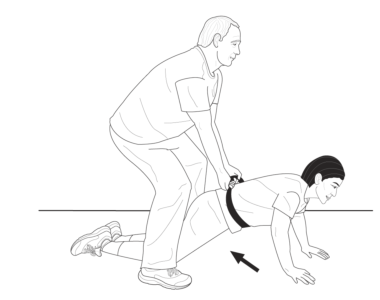
* Assisted prone to hands and knees. If the patient has strong arms, the caregiver (with proper body mechanics) can straddle the patient, grab the gait belt, and lean back while pulling up on the belt. At the same time the patient pushes with the arms (figure 11.7). As the patient walks her or his hands backward, the caregiver walks backward and guides the hips into the all-fours position.


* Assisted half kneeling to standing. The caregiver stands on the side of the patient that requires greater support. This positioning allows the patient to assist with his or her strongest side, which reduces difficulties in general. The caregiver places one hand on the gait belt and the other arm under the patient’s axilla (figure 11.8).

What to Do After a Fall

Patients often want to get up from the floor immediately after a fall. This desire may be due to the embarrassment of falling or their concern about their ability to get up. Sometimes patients do not think about the fact that after they have fallen, they cannot fall any farther and should be in no hurry to get up. Bystanders occasionally offer a helping hand, but their help may cause greater destabilization or irritate an already arthritic joint. Educating the patient about how to guide bystanders will help minimize these problems. Here are some general guidelines about what to tell your patient:

1. Do not try to get up right away.

2. Before attempting to get up, mentally note whether any areas feel injured. If you suspect injury, seek medical attention.

3. Attempt to relax for a moment before getting up.
.....

5. Before attempting to get up, someone should bring a chair close to you if needed so that you can use it for support to get up.

6. An additional chair could be placed behind you if you have difficulty turning. After you are standing, you can sit on the chair without having to turn.

This is an brief excerpt from Health Professionals’ Guide to Physical Management of Parkinson’s Disease. found on http://www.humankinetics.com/excerpts/excerpts/assisted-floor-transfer-techniques-for-patients-with-parkinsons-disease


----
A gait belt is a device used to transfer people from one position to another or from one thing to another. For example you would use a gait belt to move a patient from a standing position to a wheelchair. The gait belt is customarily made out of cotton webbing and a durable metal buckle on one end. The gait belt is worn around a patient's waist. The purpose for this is to put less strain on the back of the care giver and to provide support for the patient
--
Points to Remember: More than one caregiver may be needed. Belts with padded handles are easier to grip and increase security and control. Always transfer to resident's strongest side. Use good body mechanics and a rocking and pulling motion rather than lifting when using a belt. Belts may not be suitable for ambulation of heavy residents or residents with recent abdominal or back surgery, abdominal aneurysm, etc. Should not be used for lifting residents. Ensure belt is securely fastened and cannot be easily undone by the resident during transfer. Ensure a layer of clothing is between residents' skin and the belt to avoid abrasion. Keep resident as close as possible to caregiver during transfer. Lower bedrails, remove arms and foot rests from chairs, and other items that may obstruct the transfer

Thursday, June 10, 2010

News from Pleasantries Adult Day Services June 2010

Babies evoke a positive emotional response in most older adults. When our guests are able to hold a baby, their day is better. The interaction is priceless.The smiles shared and the sweet baby talk create a happy environment. We are lucky to have guests whose grand-children visit us.
Evie holding Jackson, Leslie's grandson
We have multiple days where children will visit and interact with our guests.
Intergenerational activity is mutually beneficial. While the children experience diminished fear of an older adult and enjoy the contact with our guests, the guest experiences a sense of increased self-worth, and an improved emotional state. My guests are able to carry the positive emotions throughout their day.
Arthur holding Jackson, Leslie's  grandson.
Now we know what has been eating our lillies!
Deer in our yard
At the breakfast table, my guest, Ann said, "There are two animals in the yard." As I looked out, I was amazed to find two deer grazing. We went out on the deck and I was able to capture them on camera as they leaped away. Pretty awesome!

Tammy Pozerycki
Owner & Director


Wednesday, June 2, 2010

Better Care of the Dying

ABCD-CARING - Americans for Better Care of the Dying - Main Page
Every dying person needs to be able to count on excellent care. Americans for Better Care of the Dying (ABCD) aims to improve end-of-life care


Wednesday, May 5, 2010

Age Strong! Live Long! May is Older Americans Month

http://www.aoa.gov/AoARoot/Index.aspx

Older Americans Month Archive
May is Older Americans Month
History of Older Americans Month

When Older Americans Month was established in 1963, only 17 million living Americans had reached their 65th birthdays. About a third of older Americans lived in poverty and there were few programs to meet their needs. Interest in older Americans and their concerns was growing, however. In April of 1963, President John F. Kennedy's meeting with the National Council of Senior Citizens served as a prelude to designating May as "Senior Citizens Month."

Thanks to President Jimmy Carter's 1980 designation, what was once called Senior Citizens Month, is now called "Older Americans Month," and has become a tradition.

Historically, Older Americans Month has been a time to acknowledge the contributions of past and current older persons to our country, in particular those who defended our country. Every President since JFK has issued a formal proclamation during or before the month of May asking that the entire nation pay tribute in some way to older persons in their communities. Older Americans Month is celebrated across the country through ceremonies, events, fairs and other such activities.

Past Older Americans Month Themes

* 1978 - Older Americans and the Family
* 1984 - Health: Make it Last a Lifetime
* 1985 - Help Yourself to Independence
* 1986 - Plan on Living the Rest of Your Life
* 1992 - Community Action Begins with You: Help Older Americans Help Themselves
* 1993 - No theme selected (proclamation signed on May 25, 1993)
* 1994 - Aging: An Experience of a Lifetime
* 1995 - Aging: Generations of Experience
* 1996 - Aging: A Lifetime Opportunity
* 1997 - Caregiving: Compassion in Action
* 1998 - Living Longer, Growing Stronger in America
* 1999 - Honor the Past, Imagine the Future: Towards a Society for All Ages
* 2000 - In the New Century. . . . The Future is Aging
* 2001 - The Many Faces of Aging
* 2002 - America: "A Community for all Ages"
* 2003 - What We Do Makes A Difference.”
* 2004 - Aging Well, Living Well
* 2005 - Celebrate Long-term Living
* 2006 - Choices For Independence
* 2007 - Making Choices for a Healthier Future
* 2008 - Working Together for Strong, Healthy and Supportive Communities
* 2009 - Living Today for a Better Tomorrow
* 2010 - Age Strong! Live Long!


Tuesday, May 4, 2010

Caregiving in the U.S. 2009

Caregiving in the U.S. 2009
By: National Alliance for Caregiving in Collaboration with AARP; Funded by The MetLife Foundation | December 2009


Monday, May 3, 2010

How to make a visit to the physician easier for AD patient.

Pleasantries Adult Day Services - Marlboro, Massachusetts - Alternative Alzheimer’s care
Tammy Pozerycki
Owner & Director

Writes in a
Pleasantries A.D.S. newsletter:
It is important that your loved one with Alzheimer's disease have regular visits to his or her physician. These visits should address all medical and behavioral issues which may be related to Alzheimer's disease. In order to experience a productive appointment with the physician, try the following suggestions:

* Choose a "good" time of day for the appointment time (most likely morning will be best.)

* Bring along an activity that your loved one enjoys (books, sorting activity, coloring, etc) as well as a snack and water. This will prepare you for an unexpected wait time.

* Bring a list of all medication including over-the-counter. Create a list of questions in preparation of the minimal time available with the doctor.

* Depending on your situation, it may be helpful to bring someone else with you, such as a close friend or family member.

* Discuss what you can expect for the future and advance directives.

* It is good to take notes as there will be much discussed in a short amount of time.

* Be open and honest. If you are not happy or satisfied with the physician, make he or she aware of your concerns. Switching physicians can be confusing to your loved one and possibly detrimental in the longrun. If discussed, the issues may be resolved.


Sunday, April 25, 2010

“if you want to die, get better and die at home.”

A Graying Population, a Graying Work Force - NYTimes.com
In an aging population, the elderly are increasingly being taken care of by the elderly. Professional caregivers — almost all of them women — are one of the fastest-growing segments of the American work force, and also one of the grayest.

A recent study by PHI National, a nonprofit organization that advocates on behalf of caregivers, found that in 2008, 28 percent of home care aides were over age 55, compared with 18 percent of women in the overall work force.

The organization projects that from 2008 to 2018, the number of direct care workers, which includes those in nursing homes, will grow to 4.3 million from 3.2 million.


Saturday, April 3, 2010

Caregiver Assitive Technologies {Purdue edu}

Rural Caregivers - Assistive Technology
For caregivers, assistive technology, especially aids for daily living (ADLs), can make a world of difference in the lives of the individuals they care for. Whether it is modified utensils, dressing and grooming aids, or mobility aids, these devices give a person more independence to do tasks they otherwise would not be able to do with out assistance. For caregivers, assistive technology can make the job of caring for a loved one much easier.

There are many places for caregivers to turn for assistance. There are many companies that sell difference assistive devices as well as many professionals who are available to offer advice, share their knowledge and offer technical assistance.


Caregiver Resources http://cobweb.ecn.purdue.edu/~bng/BNG/Caregiving/assistivetech.html


Changing the perception and experience of aging

secondwinddreams
Second Wind Dreams® was formed in 1997, growing out of the work of geriatric specialist P.K. Beville, M.S. who co-authored Second Wind, a novel about people living in a nursing home. Over the last twelve years, SWD has become involved in more than 290 eldercare communities in 40 states, Canada and India. The mission of Second Wind Dreams® (SWD) is simple: through the fulfillment of dreams and the offering of innovative educational opportunities to caregivers and communities, SWD seeks to change the perception and experience of aging, empowering elders to age with dignity, hope and joy.

Second Wind Dreams focuses on those living in eldercare communities or in hospice care. These are our seniors who need our assistance most. Family support may be non-existent, money can be at a premium, especially for our Medicaid supported seniors, and these senior adults are often our frailest— the ones who need a dream fulfilled.


Tuesday, March 23, 2010

Cohousing, a movement that started in Denmark

Cohousing building momentum in Mass. - The Boston Globe
Cohousing, a movement that started in Denmark in the 1980s, has been steadily spreading from Western Massachusetts into urban areas, and catching on with a new generation of frugal, environmentally conscious folks.

Carbon footprints and tight household budgets weigh on a lot of city dwellers’ minds, its champions point out. Security, safety, and building a sense of community do, too. Cohousing addresses all of these concerns, they maintain. For young adults and parents of growing families, it means a more neighborly way of living than an apartment complex normally offers. For seniors, it often allows “aging in place’’ with members of multiple generations.

Cheaper. Cleaner. More democratic. More congenial. More stimulating. What’s not to like?

“Massachusetts has become one of the hotbeds of cohousing,’’ said Craig Ragland, executive director of the Cohousing Association of the United States. By Ragland’s count, there are 120 established cohousing communities across the country, including preexisting neighborhood complexes retrofitted to the cohousing model.


Wednesday, February 10, 2010

"Healthy Solutions Chat" Tele-Seminar

Healthy Solutions Tele-Seminar
Bring Your Questions and a Friend Every Monday

9pm Eastern, 6pm Pacific Time

The buddy system works for creating positive change in your life!

Every Monday you can get health advice you can trust ...

and the support you need to move consistently toward your health goals.


Saturday, February 6, 2010

NFCA, National Family Caregivers Association

The National Family Caregivers Association educates, supports, empowers and speaks up for the more than 50 million Americans who care for loved ones with a chronic illness or disability or the frailties of old age. NFCA reaches across the boundaries of diagnoses, relationships, and life stages to help transform family caregivers' lives by removing barriers to health and well being.

Membership is free to family caregivers, and includes a quarterly, e-mailed newsletter. For those who would rather receive a print copy of the newsletter, NFCA offers an upgraded, Family Caregiver Plus membership at the special introductory rate of $10/year. Click here to join on-line.

Friday, February 5, 2010

Retired? Cleaning products are a mystery under the kitchen sink

Cleanser makers told to come clean - The Boston Globe
Some studies have linked cleaning product components to asthma, antibiotic resistance, hormone changes, and other health problems. ...

Federal environmental laws don’t require most household cleaning products to list their ingredients, though there are congressional proposals to change that. The Consumer Product Safety Commission requires hazard warning labels on some cleansers, and the National Institutes of Health offer some health and safety information for hundreds of cleaning products, drawn from data gathered for industrial use.


Monday, February 1, 2010

Raise your hand if you're a caregiver.

How Can Doctors and Caregivers Work Together?

from: HealthBridge's In-Home Care Blog

Dr. Pauline Chen took an insightful look at this topic in her "Doctor and Patient" column in the New York Times. She writes:

For all our assertions about the importance of caring in what we do, doctors as a profession have been slow to recognize family members and loved ones who care for patients at home. These “family caregivers” do work that is complex, physically challenging and critical to a patient’s overall well-being, like dressing wounds, dispensing medication, and feeding, bathing and dressing those who can no longer do so themselves.

Many of these caregiving tasks were once the purview of doctors and nurses, a central component of the “caring professions.” But over the past century, as these duties increasingly fell to individuals with little or no training, doctors and even some nurses began to confer less importance, and status, to the work of caregiving.


nightmare for those with disabilities who are struggling to stay at home.

http://www.kaiserhealthnews.org/Columns/2010/February/020110Gleckman.aspx

Feb 01, 2010


There are programs run by states and similar projects run out of Washington. This is a particular nightmare for those with disabilities who are struggling to stay at home. If you don’t believe me, try to find a local phone number for elder care assistance.


Sunday, January 17, 2010

The end of the office... and the future of work - The Boston Globe

The end of the office... and the future of work - The Boston Globe


We love to hate the workplace, but we’ll miss it when it’s gone

------------------------------------------------------------------

Work Without Boundaries Networking facilitates working around the world.
http://groups.google.com/group/wwboundaries_network


Communities are ill-prepared to meet the need for senior services

Communities south of Boston face dramatic increase in senior population, demand for elder services - The Boston Globe
“Tomorrow’s seniors are not your father’s grandfathers,’’ said Timothy G. Reardon, senior regional planner for the Metropolitan Area Planning Council, which analyzed demographic trends including births, deaths, and migration and other factors to forecast the changes in populations. “COAs and other organizations that work with seniors must rethink the types of services they provide. It’s not going to be all meals on wheels and Sunday suppers at the COA hall.’’


Wednesday, January 13, 2010

"Where America Stands" on the growing Alzheimer's epidemic ..

Dr. Jon LaPook CBS alzheimers - Google News
CBS News chief medical correspondent, Dr. Jon LaPook speaks with CBSNews.com's Cali Carlin about "Where America Stands" on the growing Alzheimer's epidemic ..


Sunday, January 10, 2010

Retirees - Seniors: connect family and friends during a serious health event, care and recovery

CaringBridge. A Nonprofit Web Service Providing Free Websites During Critical Illness.
About CaringBridge

CaringBridge is a 501(c)(3) nonprofit providing free websites that connect family and friends during a serious health event, care and recovery.

A CaringBridge website is personal, private and available 24/7. It helps ease the burden of keeping family and friends informed. The websites are easy to create and use. Authors add health updates and photos to share their story while visitors leave messages of love and support in the guestbook.


Saturday, January 9, 2010

Service Opportunities After Reaching 55, or Soar 55

Volunteer group opening Framingham office - Framingham, MA - The MetroWest Daily News
By Michael Morton/Daily News staff
MetroWest Daily News
Posted Jan 09, 2010 @ 12:31 AM
FRAMINGHAM —

A program that matches the talents and interests of residents 55 and older with volunteer opportunities plans to expand from its Newton branch to a new MetroWest satellite office.

Service Opportunities After Reaching 55, or Soar 55, a program of the Newton Community Service Center, has secured permission to use space in Framingham's central library at 49 Lexington St.

The organization will hold an open house Jan. 20 from 7 p.m. to 8:30 p.m. in the library's Costin Room, with existing volunteers discussing their experiences. State Sen. Karen Spilka, D-Ashland, is scheduled to speak.

Attendees can also meet Lois Levick, the group's new Framingham coordinator.

Those interested in attending are asked to RSVP by sending an e-mail to kalbert@ncscweb.org.

(Michael Morton can be reached at mmorton@cnc.com or 508-626-4338.)


Thursday, December 24, 2009

pension: company had long since been swallowed and reswallowed in a series of corporate mergers

To track a pension, help is out there - The Boston Globe
New England Pension Assistance Project at the University of Massachusetts Boston, a federally funded organization that works to connect retirees with lost pensions.


Ken and Daria Dolan's Scams That Target Seniors

Thanks to Mike Gamble, Sarasota, FL for Tweeting

Top Scams That Target Seniors - WalletPop
Top Scams That Target Seniors
By Ken and Daria Dolan, Dolans.com

{ Ken and Dana ask you to Please be sure to share these senior scams with your friends and loved ones so they don't become a victim.}

Seniors are one of scam artist’s favorite targets. More than 25 million seniors were victims of fraud last year according to the Federal Trade Commission. Seniors become targets because they are easy to reach by phone, are often home during the day, often live along, and are often more willing to talk to strangers.
The Dolans
Jamie Koslow, AOL
Today, personal finance experts Ken and Daria Dolan of Dolans.com expose seven top scams that target seniors. Even if you aren't a senior yourself, keep reading and warn the seniors in your life about these scams.
Scam No. 1: Reverse Equity Mortgage Scam
Thanks to the stock market meltdown and housing collapse, many Americans in their 60s and older do not have a lot of savings on which to fall back. Many of these folks are wondering whether a reverse equity mortgage is right for them ... and scammers smell an easy target. The FBI recently issued a warning that reverse mortgage scams have skyrocketed. Since 1999, reverse mortgage scams have increased 1,300%!
Plus, the Government Accountability Office (GAO) finds that many reverse mortgage "counseling programs" being offered are in fact shills for lenders looking to rip the elderly. Of the 15 organizations the GAO investigated undercover, not ONE conveyed unbiased, sound information about reverse mortgages.
A reverse equity mortgage may be an effective way to generate income in retirement, but you must carefully consider all of the pros and cons and be sure you are working with a legitimate company.
More From The Dolans:

* 10 Smart Money Moves for 2010
* Top 10 Tips to Avoid Scams
* Money "Deals" You Should Refuse

Scam No. 2: Fake E-mail From the Social Security Administration
There are many variations of these fake messages circulating, but they all claim there is something wrong with your Social Security benefits and that convince you to click the link provided to clear up the problem. Here's a sample:
"Due to possible calculation errors, your annual Social Security statement may contain errors. Use the link below to review your annual Social Security statement."
The scammers have done a good job making these e-mails look legitimate. They use a ".gov" e-mail address as all government sites use. Some messages even contain the Social Security Administration logo, making them look very official.
Don't fall for it! These e-mails are NOT from the Social Security Administration. Their sole purpose, as with most e-mail scams, is to trick you into sharing important information that will help the scammer steal your identity, access your bank account or otherwise cause you financial harm.
The Social Security Administration does NOT contact consumers through e-mail, period.
Scam No. 3: Impersonating a Grandchild in Trouble
This one is really low. Let us tell you what happened to Rose, who lives in a seniors' community in Pompano Beach Florida, to show you how this one works. Rose received a phone call one afternoon from a young man saying "Grandmom, I need your help, my car just broke down and I need some money to get it fixed."
Recognizing the voice wasn't one of her grandson’s, she assumed it was her granddaughter's boyfriend. "Brian is that you," she asked. "Yea Grandmom, it's me Brian," he replied. "I need your help -- do you think you could send me some money?" Then he asked for $1,000!
Now, Rose is a smart lady and wasn’t quite sure who she was talking to, so she said she probably wouldn't be able to help. "But Grandmom, it's me Brian," pleaded the man on the phone, "I really need your help."
Another popular variation on this scam is the scammer claiming they are in jail and need bail. Wait, it gets worse! If the scamster actually gets money, they'll have a second person call pretending to be a police officer, who will claim there are extra charges for property damage or fines and ask for more money!
The typical take on this scam is about $3,000! Be smart like Rose ... NEVER give out personal bank account info over the phone or send money through a wire service at someone else's request.
Scam No. 4: Home Repair Scams
This scam targets seniors who live at home -- often elderly women who live alone. A nice guy shows up at your door and offers to do some handyman projects around the house -- could be gutter cleaning, for example.
But once these scammers gain the person's trust, they trump up unnecessary work that needs to be done and charge huge amounts of money for it. They might claim your roof needs repair, or that they saw a problem with wood rotting on your porch. Police call these fake home contractors "woodchucks." We expect a slew of home improvement scams targeting seniors to crop up now using the President’s "Cash for Caulkers" program as an excuse to get in the door. Be vigilant!
Scam No. 5: Prepaid Funeral Scam
A funeral can be one of the most expensive purchases you will ever make. A typical funeral costs about $6,000, but costs can go as high as $10,000. To spare their families from expenses and decision-making during this emotional time, a growing number of people are pre-paying their funeral expenses.
The idea is that you pre-pay for your funeral and those funds are held in escrow, in a trust or used to buy life insurance that would cover funeral expenses when you die.
But pre-paid funeral scams swindle millions of dollars each year. In the worst scams, people take your money and run. In others, you simply get sold an expensive package that costs much more than you need to spend. The last thing grieving relatives need is to find out you were ripped off and there is a large unexpected funeral expense with which to deal.
Scam No. 6: Medicare Fraud Scams
Medicare users are a favorite scam target. Some scammers offer seniors free medical products -- all they have to do is give them their Medicare number. Another common ploy is to tell a senior that their Medicare card has expired and they need to provide their Medicare number to get a new one.
In both scenarios, the scam artist steals that number and uses it to complete a form, obtain certification from an unauthorized doctor, and bill Medicare for reimbursement.
Never provide your Medicare number to someone over the phone. And never sign incomplete insurance forms or provide blanket authorization to a medical provider to bill for services.
Scam No. 7: Investment Scams
Although seniors aged 60 or older make up just 15% of the U.S. population, they account for 30% of investment fraud victims, according to the North American Securities Administration Association.
Here are some typical investment scams to watch out for:
· Ponzi scams that promise HUGE returns. We saw a commercial on TV offering an investment that would pay a 40% annual return for MANY years! C’mon folks .. .that just doesn't pass the sniff test!
· Financial "advisors" who prey on widows and widowers -- be very wary of anyone who contacts you offering to help you with your finances soon after your spouse dies. There are unethical people looking to take advantage of you during this emotional time!
· Free investment seminars hosted by some "investment pros" over lunch or dinner. Chances are you will get the hard sell while you are there (or endless phone calls afterwards) for speculative, inappropriate investments.
· High yield investment scams. At a time when many seniors could use some extra money, unscrupulous advisors are peddling products that have the highest yield -- and promising you safety of your investments that just isn’t true.
· Annuities -- there's a special place in hell for people who profit from selling an 83 year old on fixed income an annuity that's not appropriate for him ... "it’s the same as a CD" they say. Thanks to their fat commissions, far too many annuities are sold to people who shouldn't own them. Be very wary of annuity pitches.
Please be sure to share these senior scams with your friends and loved ones so they don't become a victim. And be sure to follow our simple scam prevention tips to protect yourself and your loved ones.